
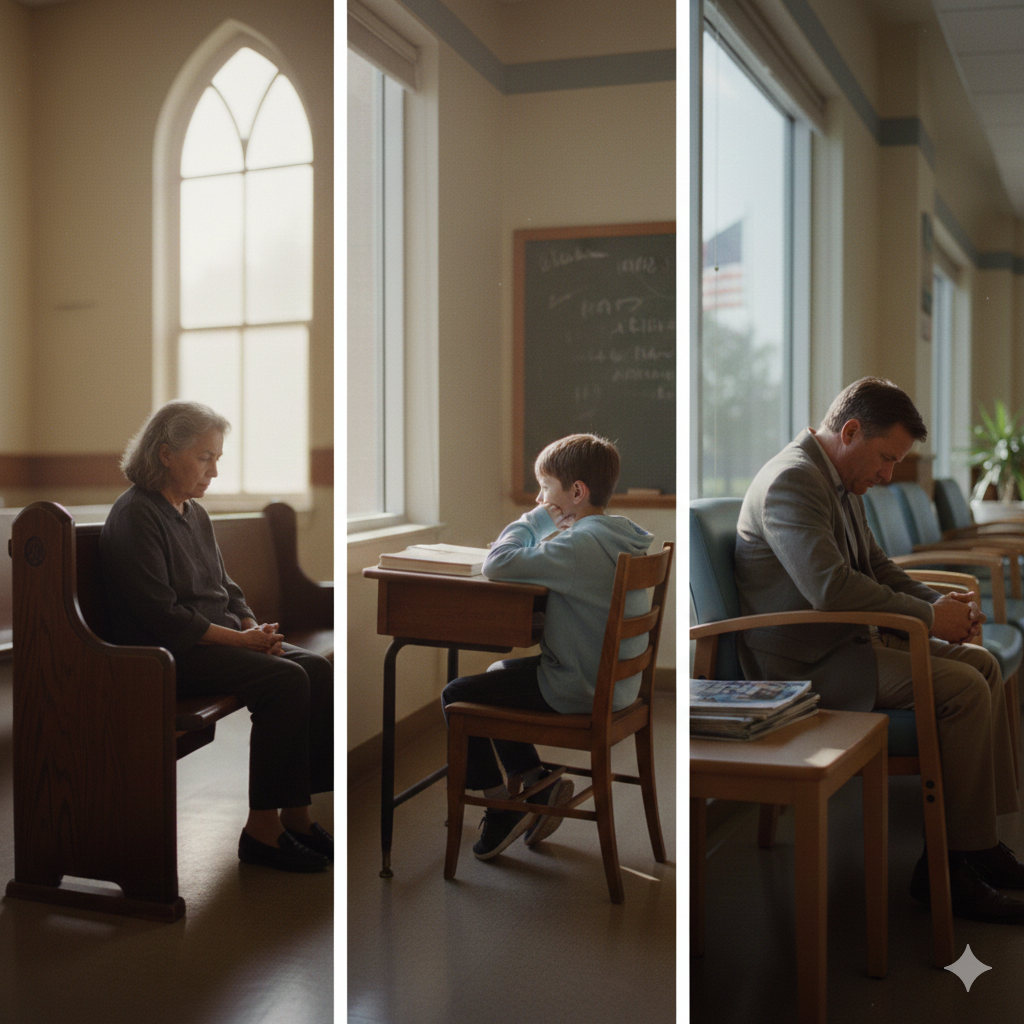
For most Americans, the phrase separation of church and state feels constitutional. It sounds settled.
But the phrase does not appear in the Constitution.
The First Amendment says:
“Congress shall make no law respecting an establishment of religion, or prohibiting the free exercise thereof…”
Two protections. Not one.
Government may not establish a church.
Government may not prohibit the free exercise of religion.
The Founders were reacting to state-controlled religion in Europe. In England, citizens were taxed to support the Church of England, and dissenters were often barred from public office. Their concern was coercion — not religious expression.
Jefferson’s “Wall”
The phrase comes from an 1802 letter written by Thomas Jefferson to the Danbury Baptists.
Jefferson described a “wall of separation between church and state.”
The Baptists feared government interference in religion. Jefferson reassured them that the federal government would not establish or control a church.
The wall was meant to protect the church from the state.
It was not meant to insulate the state from moral influence.
That distinction is crucial.
The Judicial Shift
In the early 1960s, the tone changed.
In Engel v. Vitale (1962), the Supreme Court ruled against state-sponsored school prayer. In Abington School District v. Schempp (1963), school-sponsored Bible readings were struck down in public schools.
Private prayer remained legal.
But culturally, the message was received differently.
Religion no longer appeared welcome in government-run spaces.
Over time, “separation” began to feel less like protection and more like quarantine.
The 1980s: When Even Student Prayer Felt Risky
By the 1980s, the tension deepened.
In many schools, students who tried to organize voluntary, student-led prayer groups were told they could not meet on campus. No teachers. No school sponsorship. Just students.
Administrators, wary of lawsuits, often overcorrected. Anything religious felt legally dangerous.
Yet the law did not forbid student prayer.
In 1990, the Supreme Court ruled that if public schools allowed non-curricular clubs — chess club, drama club, debate club — they could not deny equal access to student religious clubs. Student-led, voluntary religious expression was protected.
But culturally, the damage had already been done.
For a generation of students, the message was clear: religion in school is a problem to manage.
The shift was no longer just constitutional interpretation. It was institutional discomfort.
Crisis and the Question of “Essential”
The tension resurfaced in a new form during the COVID-19 pandemic.
In state after state, governors issued emergency orders restricting indoor gatherings. In many jurisdictions, churches were closed or heavily limited while large retail stores remained open.
Officials often argued that retail environments involved shorter, more transient interactions, while worship services involved prolonged indoor gatherings. Early in the pandemic, courts largely deferred to emergency public health authority.
But as the months passed, the Supreme Court clarified that governments could not treat religious worship as less essential than comparable secular activities. If grocery stores and retail outlets could operate under certain capacity rules, houses of worship could not be singled out for harsher treatment.
The constitutional issue was eventually corrected.
But the episode raised a deeper cultural question:
When crisis comes, what do we instinctively label as essential?
Commerce was assumed to be necessary.
Worship had to argue its case.
That instinct is revealing.
When Faith Became Suspicious
The shift has also appeared in tone and language.
In 2017, during a confirmation hearing, Senator Dianne Feinstein told judicial nominee Amy Coney Barrett:
“The dogma lives loudly within you.”
The comment was widely interpreted as suggesting that deep religious conviction might be disqualifying for public service.
The Constitution explicitly forbids religious tests for office.
Even the appearance of such a test signals a cultural shift.
The concern is not that public officials hold beliefs.
The concern seems to arise when those beliefs are Christian — and unapologetic.
Why Separation of Church and State Matters Today
The Moral Parallel
Beginning in the 1960s, America experienced a period of dramatic moral and social change:
- Divorce rates roughly doubled between 1960 and 1980.
- Out-of-wedlock births rose from about 5% in 1960 to over 40% today.
- Violent crime surged from the mid-1960s into the early 1990s.
No single court case caused these outcomes.
But the parallel is difficult to ignore.
For nearly two centuries, American culture operated within an assumed moral framework rooted in Christian thought — not imposed, but present. It shaped ideas of human dignity, covenant, responsibility, sacrifice, and restraint.
As public institutions secularized, that shared framework weakened.
When a society removes its transcendent reference point, moral authority does not disappear.
It transfers.
The Neutrality Myth
Secularization was framed as neutrality.
But neutrality is never truly neutral.
Every law rests on moral assumptions:
Human life has value.
Marriage has meaning.
Justice exists.
Rights are inherent.
The deeper question is whether those assumptions are relative or absolute — a question I explored in Are Morals Relative — Or Absolute?
If religious moral reasoning is excluded from public life, what replaces it?
The state?
Majority opinion?
Cultural trends?
A nation can choose to move away from its religious roots.
What it cannot do is avoid the consequences of redefining its moral foundation.
The Real Question
The Founders did not establish a theocracy.
They established a republic where religion was free — and where moral conviction was not disqualifying.
Yet over time, protection became suspicion.
Separation became silence.
I’m finishing these thoughts while sitting in a waiting room at Duke for my wife’s LVAD checkup and a Prolia bone density injection — two very different reminders of what it takes to keep a body functioning when its natural strength begins to fade.
An LVAD doesn’t replace the heart; it supports it when it can no longer carry the full load. Prolia doesn’t make someone young again; it slows the thinning of the bones so the structure doesn’t fail under ordinary weight.
Modern medicine understands something simple: when foundations weaken, you don’t pretend everything is fine. You reinforce. You monitor. You intervene before collapse.
It makes me wonder whether cultures require the same vigilance.
For generations, America assumed moral strength was self-sustaining — as though the structure could hold indefinitely without its original supports.
But structures don’t work that way.
Whether it’s a heart, a hip, or a nation — once the framework begins to fail, everything built upon it eventually feels the strain.
I’m Wayne — and that’s my world view. What’s yours?


A very fine article, Wayne.
Thanks for the feedback, Scott. Looking forward to seeing you at the reunion. Cheers, Wayne