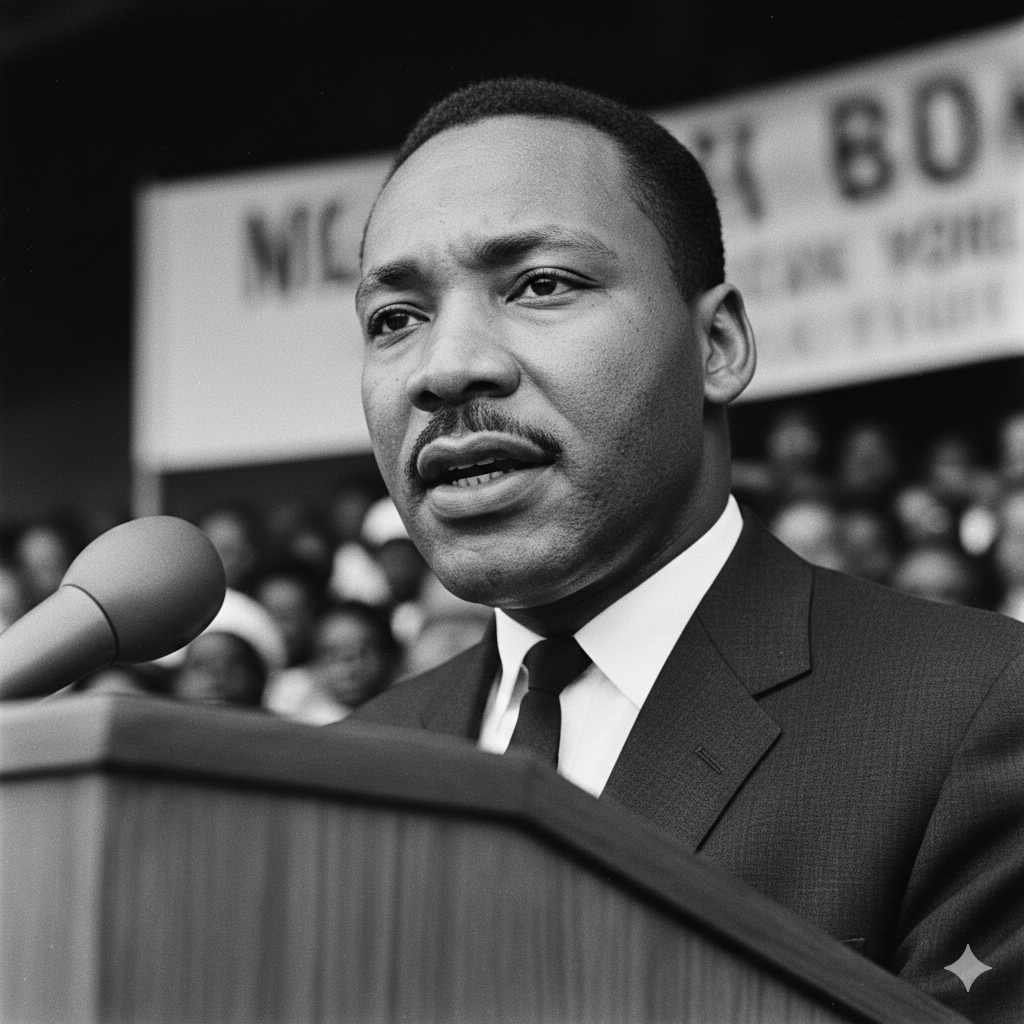
Tomorrow is Martin Luther King Jr. Day, a time reserved to remember a great man and a great American.
I was ten when Martin Luther King Jr. was assassinated.
I didn’t grasp politics.
I didn’t understand movements.
But I recognized truth when I heard it.
His words cut through clearly even to a child—dignity, justice, the promise that America could rise above its cruelest impulses. That truth mattered then. It matters still. Honoring him tomorrow is fitting. He earned his place in our national memory.
What troubles me now isn’t King himself, but what we’ve made of him.
Somewhere along the line, MLK ceased being the man who spoke uncomfortable moral truth and became a protected monument. His words are treated as cultural patrimony, his legacy shielded by unspoken rules. It has grown quietly taboo to offer even measured, honest critique—not malicious, not sensational, simply candid.
That isn’t how mature societies honor greatness.
King was extraordinary by any measure: courageous, convicted, willing to pay the ultimate price. Yet he remained a man—shaped by his era, pressed by circumstance, as vulnerable as any of us to human weakness.
Admitting that does not diminish his legacy.
It restores it.
When we insist our heroes must be flawless, we don’t protect them—we render them brittle, distant, ultimately unusable. Icons can be invoked or silenced, depending on who holds the microphone. They cannot guide living people through living struggles.
Look at the biblical King David: a warrior-poet who slew giants, united a kingdom, and penned psalms of profound devotion—yet he committed adultery and orchestrated murder to cover it. Scripture doesn’t erase his sins; it records them alongside his repentance and God’s enduring use of him.
Or consider Thomas Jefferson, who penned the immortal words “all men are created equal” while owning hundreds of enslaved people, including those with whom he fathered children. His vision helped birth a nation dedicated to liberty, even as his life betrayed it in the most personal ways.
And John F. Kennedy, whose charisma and resolve during the Cuban Missile Crisis inspired a generation—yet whose private life was marked by documented extramarital affairs and the concealment of debilitating health struggles.
These men, like King, achieved greatness not because they were perfect, but because they stood under moral truth, wrestled with their failings, and still moved history forward.
The danger deepens when only certain voices are deemed permitted to quote them, to appeal to their dreams of unity or justice, or to claim their vision. When their messages become heritage in one mouth but appropriation in another, the principle itself dissolves.
This is an ancient problem, older than any political party.
With one singular exception—Jesus Christ—every leader, reformer, and hero stands subject to failure, blind spots, and temptation. Christianity has always been unflinchingly honest about this, because truth itself depends on it.
Heroes can inspire.
They cannot save.
As we remember Martin Luther King Jr. tomorrow, let us do it the way that lasts: not by polishing him into something untouchable, but by honoring him honestly—as a man who stood under moral truth, not above it, and whose words still call us forward because they came from someone who wrestled with the same human frailty we all know.
That is how we should remember our great Americans.
I’m Wayne – and that’s my world view. What’s yours?