
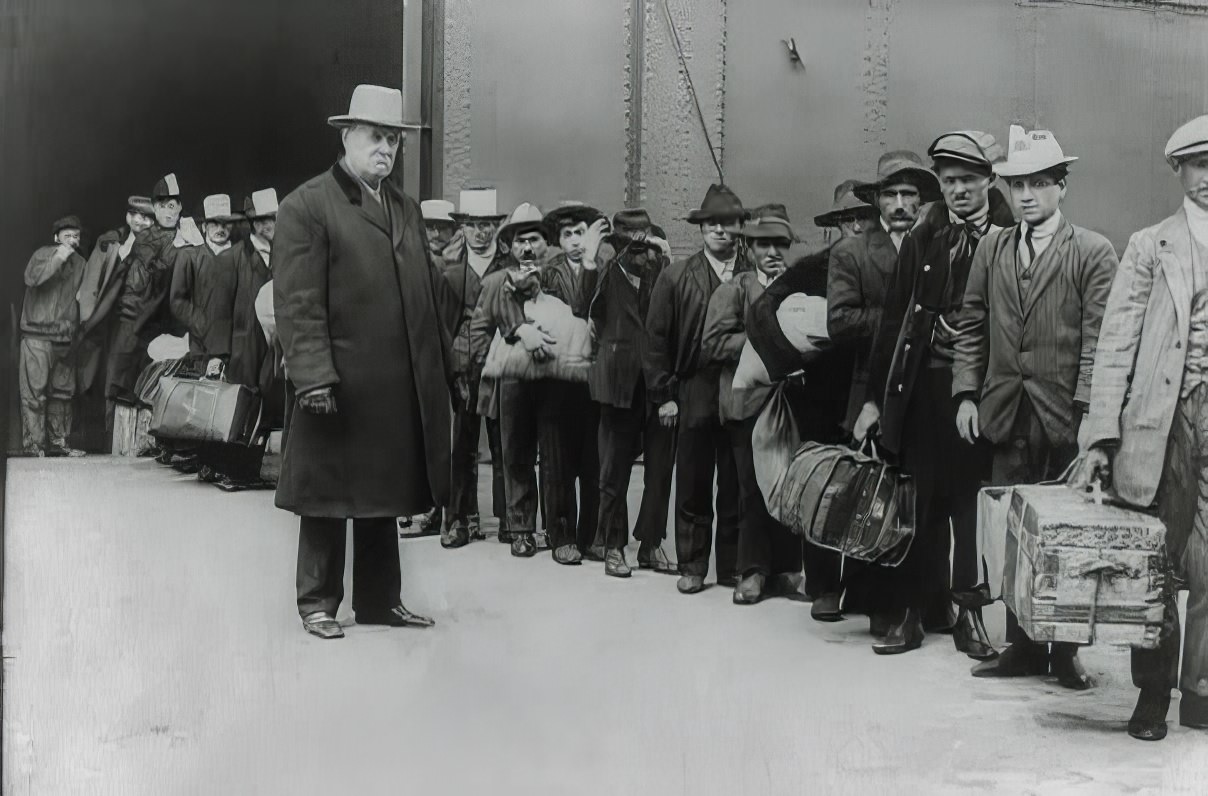
America is often described as a nation of immigrants. That is true—but only because it is inseparable from its founding principle:
E Pluribus Unum — Out of many, one.
America was never meant to be a blank slate or a permanent hostel for competing civilizations. It was designed to take people from many origins and forge something new: one people, united by a shared civic identity.
In plain terms:
One people, drawn from many places.
WHAT AMERICA IS
America is a civic nation, not an ethnic one. It is united by allegiance, not ancestry, and governed by uniform civil law—not religious law.
Immigrants were always welcome—but on a clear condition: old political loyalties are abandoned, competing legal systems are rejected, and prior social orders are subordinated to the American civic framework.
Personal history is not erased.
But citizenship comes first.
WHAT AMERICA IS NOT
America is not a hotel where guests rewrite the rules. It is not a centerless multicultural experiment. It is not a patchwork of parallel communities or a nation of permanent hyphenated loyalties.
When group identity supersedes citizenship, unity erodes.
E Pluribus Unum does not mean out of many, many remain.
It means out of many, one people emerges.
THE ROOSEVELT STANDARD
“There is no room in this country for hyphenated Americanism… We have room for but one flag, one loyalty, and one language.” — Theodore Roosevelt
THE CORE PRINCIPLE
You do not join America to remake it in the image of the society you left.
You adapt—or you do not fully belong.
WHERE ASSIMILATION BREAKS DOWN
Assimilation fails not over food, clothing, or private worship—but over authority.
It fails when belief systems reject secular civil law, discourage integration, maintain transnational loyalties, or treat criticism as persecution.
When that happens, parallel societies form.
Not pluralism—fragmentation.
THE EXPLICIT RISK AMERICA MUST CONFRONT
The danger posed by large-scale Muslim immigration is not that Muslims arrive with violent intent.
The danger is ideological and structural.
Certain forms of political Islam openly reject the separation of religion and state, deny the legitimacy of secular authority, and view demographic growth combined with institutional pressure as a legitimate means of shaping society.
No conspiracy is required.
Only time, numbers, and hesitation.
When populations resist assimilation, organize politically around religious identity, demand exemptions from neutral law, and pressure institutions to self-censor, demographics become leverage—and leverage reshapes norms.
That is not conquest by force.
It is erosion by insistence.
WHAT THE FOUNDERS MEANT BY SEPARATION OF CHURCH AND STATE
When the Founders spoke of separating church and state, they were not arguing for a secular or morally neutral society.
They understood—explicitly—that the American system of self-government would only function among a moral and religious people, and that religion was Christianity.
Separation of church and state was intended to prevent a state-controlled church and a church wielding coercive political power—not to remove religion from public life.
Liberty depended on self-governance before government governance.
Moral restraint was expected to come from conscience and faith, not constant state enforcement.
Christian ethics—personal responsibility, restraint, honesty, duty, sacrifice—were assumed as the cultural foundation that made limited government possible.
When that moral consensus erodes, liberty collapses into regulation or chaos.
The Founders never believed a pluralistic moral vacuum could sustain a free republic.
THE LINE THAT PRESERVES AMERICA
Anyone may come here.
Everyone lives under the same law.
No group reshapes the civil order it entered.
A FORGOTTEN AMERICAN LESSON
“Ask not what your country can do for you—ask what you can do for your country.” — John F. Kennedy
That was not rhetoric.
It was a civic warning.
Freedom survives only when citizens see themselves as stewards, not customers.
Citizenship was never meant to be transactional.
You are not American so you can demand from the government.
You are American because you are willing to carry the burden of preserving liberty for future generations.
BOTTOM LINE
You do not become American by adding a label.
You become American by dropping them. Out of many—one.
I’m Wayne – and that’s my world view. What’s yours?