
I’ve always enjoyed working in a shop environment; the teamwork is a big part of it, but it can also lead to some lively discussions. Between the work on the floor and the thousands of steps I’ll put in today, you can always count on a debate about the latest headline.
Today, the topic was FACE Act enforcement.
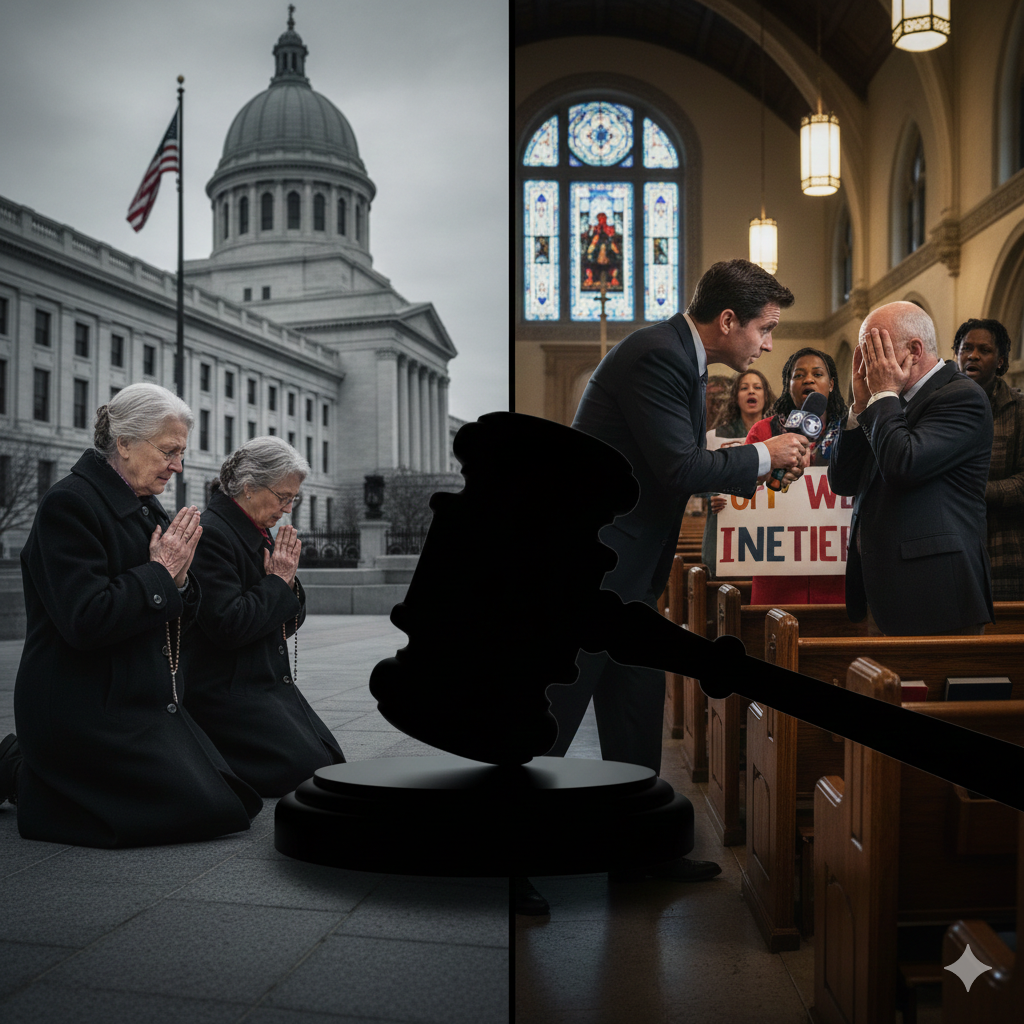
For nearly three decades, FACE Act enforcement functioned as a one-way street—a hammer kept in a glass case to be broken only when the “wrong” people were praying on a sidewalk. We saw it reach its peak just a couple of years ago when grandmothers like Paulette Harlow and Joan Andrews Bell—women in their 70s with failing health—were handed two-year federal sentences for “conspiracy” tied to pro-life demonstrations.
But as I write this today, the sword has changed hands.
The Arrogance in St. Paul
Up in Minnesota this afternoon, the news is dominated by a name we all know: Don Lemon. He walked into a federal courthouse to plead “not guilty” to charges that would have been unthinkable for someone in his position just a few years ago.
He’s being charged under that very same statute.
The indictment describes a scene at Cities Church in St. Paul where Lemon and a group allegedly disrupted a Sunday service—blocking aisles and confronting the pastor during worship.
The statute itself, codified in federal law, makes it illegal to intentionally obstruct access to religious worship or reproductive health services.
To Lemon, this was journalism.
Under current FACE Act enforcement, prosecutors argue it may constitute interference with the right to worship free from intimidation or obstruction.
For decades, the Religious Exercise clause of the law—which protects houses of worship just as strictly as clinics—sat largely dormant. Now it is being tested.
The Mississippi Momentum
While watching this unfold from North Carolina, I’m also paying attention to Mississippi. Pastor Shane Vaughn has spoken publicly about a broader legal strategy challenging what critics describe as selective enforcement.
That effort connects to Mississippi Senate Resolution 27, introduced recently, calling for repeal of the FACE Act and labeling it irreparably compromised by partisan application. The resolution references the January 2025 pardons of several pro-life activists as evidence that prior enforcement decisions were deeply contested.
Whether one agrees or disagrees, the political ground is shifting.
FACE Act Enforcement as a Litmus Test
Don Lemon may now represent a visible stress test for FACE Act enforcement.
For years, critics argued the law was used primarily in one direction. Supporters insisted it protected access and safety regardless of ideology. Now the public is watching to see whether the statute is applied consistently when the roles reverse.
That is the real issue.
If a law only applies when your opponent breaks it, it isn’t functioning as law—it’s functioning as leverage.
True justice requires a grounding that does not shift with the political winds. It requires moral realism—the ability to judge actions independent of the popularity of the person committing them.
As I argued in my recent piece on moral realism and universal standards, justice cannot survive if its standards shift with power.
Laws reveal their character not when they punish the obscure, but when they restrain the influential. Equal justice is not a slogan. It is a stress test.
The hammer may be falling in a different direction now. The only question is whether the people who forged it believe it should fall evenly.
I’m Wayne — and that’s my world view. What’s yours?