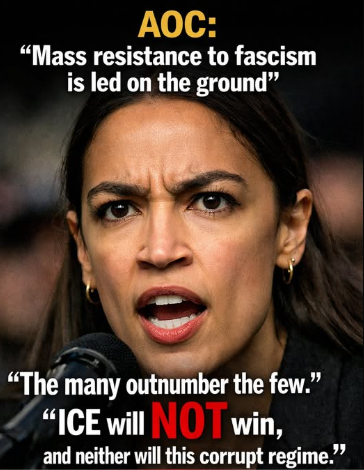
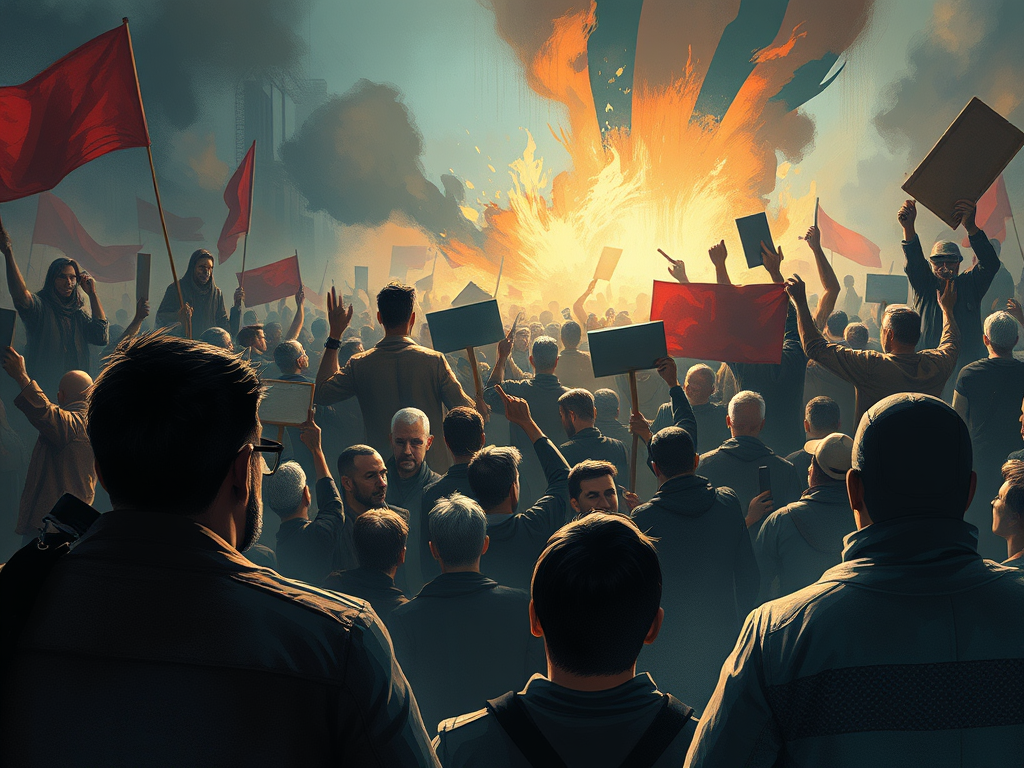
There is a noticeable shift happening in the language of protest.
What once centered on grievances and demands is now increasingly framed in terms of confrontation—resistance, war, even calls to arm oneself. That shift matters. Once violence enters the narrative, restraint is no longer seen as wisdom but as betrayal. Chaos begins to justify itself.
But there is a fundamental misunderstanding about how these moments actually work.
The loudest voices in the street are rarely the ones in control.
The real power behind modern unrest operates quietly, offstage. It coordinates logistics, shapes narratives, times flashpoints, and directs momentum—while keeping its own hands clean. The people absorbing the risk are not the people making the decisions.
And not everyone in the crowd is the same.
Some individuals show up for no other reason than to agitate and destroy. They are provocateurs—people who thrive on confrontation, vandalism, and escalation. Chaos is not a byproduct for them; it is the objective. A provocateur doesn’t persuade; he provokes. He doesn’t lead; he escalates.
Experienced organizers understand this dynamic and quietly steer these provocateurs toward pressure points, positioning them at the front of crowds or near moments of escalation. Not official leaders, but functional ones—informal enforcers, catalysts, platoon sergeants of disorder.
They escalate. Others follow.
Most participants, however, are not malicious. Many are sincere, emotional, and morally convinced. But they are reactive, not strategic. They move where the crowd moves. They chant what they are given. They follow cues they don’t recognize as cues.
Not villains.
Not masterminds.
Just directed.
This kind of unrest is not organic. It is managed. Risk flows downward. Accountability dissolves upward. When consequences arrive, the architects are nowhere to be found.
This isn’t new—it’s just more efficient.
Back around 2011, when events like the Arab Spring unfolded, social media was still crude as a coordination tool. Think of it like an early World War I fighter plane—slow, clumsy, barely controllable by modern standards. Revolutionary for its time, but limited. Influence was visible. Manipulation required effort, exposure, and risk. You could usually see who was flying the plane.
That is not the world we are in now.
By 2026, social media is no longer a canvas-and-wire biplane, or even a World War II fighter with raw speed and firepower. It is a modern stealth fighter—algorithmically guided, precision-targeted, and largely invisible until it has already passed overhead.
Messages are no longer broadcast; they are delivered.
Narratives are no longer shouted; they are inserted.
Outrage is no longer spontaneous; it is shaped.
And this is why crowds matter so much.
Crowds have a way of stripping people of their individuality. What begins as personal conviction dissolves into collective emotion. Responsibility diffuses. Moral clarity blurs. People will say and do things in a crowd they would never say or do alone—and afterward, many struggle to explain why they went along.
The Bible records one of the clearest examples of this dynamic.
Presented with a choice between Jesus and Barabbas, the crowd chose Barabbas.
Not because each person had carefully examined the evidence.
Not because they had thoughtfully weighed justice or truth.
But because crowds don’t deliberate—they react.
Once the chant began, individual conscience no longer mattered. The moment overtook the person. That scene wasn’t just theological—it was a lesson in human nature.
Crowds don’t merely amplify voices.
They overwrite judgment.
That is why crowds are so easily steered. That is why provocateurs thrive within them. And that is why those operating behind the scenes prefer mobs to individuals. A crowd doesn’t ask who benefits. It doesn’t demand accountability. It just moves.
Which brings us to an older instruction—one that feels increasingly out of step with modern expectations.
We were not told to become soldiers charging headlong into chaos. We were told to be watchmen on the wall.
The watchman observes.
He warns.
He speaks truth clearly.
But he does not rush into the breach simply to feel righteous.
History, in its broad contours, has already been written. Not in the sense that choices don’t matter—but in the sense that human patterns repeat. Pride, fear, mob psychology, false righteousness, manipulation of crowds—all of it is documented, preserved, and studied. The Bible remains one of the most scrutinized and enduring records of those patterns.
This is not an excuse for apathy.
It is a call to discernment.
In an age that demands immediate action, discernment looks like hesitation. In an age addicted to outrage, restraint looks like cowardice. But refusing to be swept into managed chaos is not surrender—it is resistance of a different kind.
The battlefield has changed.
The manipulation is stealthier.
But the duty of the watchman has not.
In a time that rewards noise and chaos, I choose the watchman’s tower over the battlefield.
I’m Wayne—and that’s my world view. What’s yours?